Becoming Green Room
For most of this project's life, the working name was a placeholder — a folder name that stuck around longer than it should have. It described the app (a reader) and nothing about what made it different. Then we shipped the feature where you long-press a character's name mid-chapter and ask them something, and they answer in character, from inside the book, never knowing more than the page you're on. That feature needed a name, and the name it got was "the Green Room" — backstage, where the cast is waiting, out of costume but still in character enough to talk to you.
The problem was we liked that name a lot more than we liked the app's actual name. So we changed the app's name instead of the feature's.
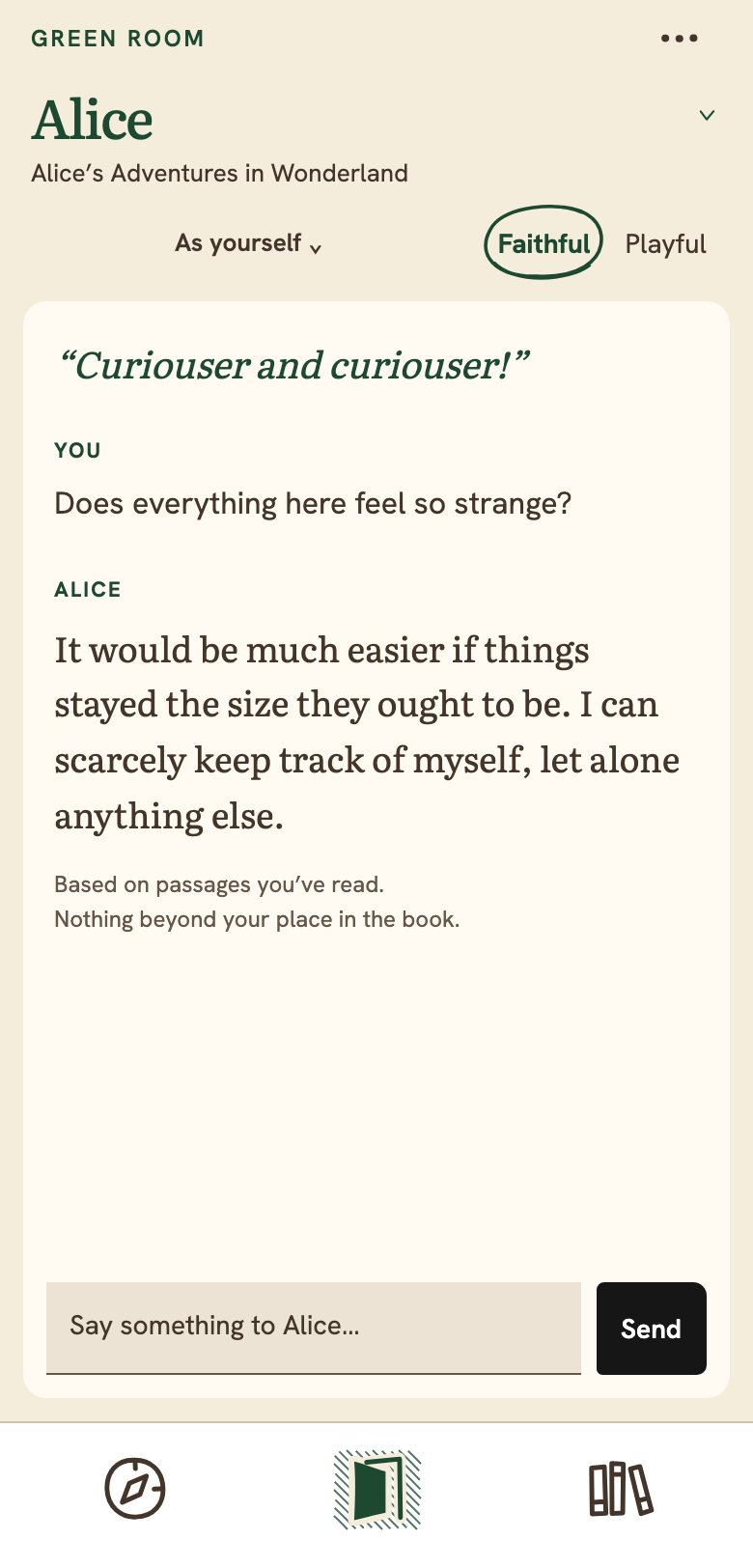
That's a mid-course correction, not a plan we're pretending we had from the start, and we'd rather say that plainly than write a founding-story paragraph implying otherwise. The feature turned out to be the most distinctive thing about the product. Naming the whole thing after it was the honest move once that became obvious, not before.
The rebrand touched more than a wordmark. The landing page got rebuilt around the actual demo — long-press a name, ask "Do you marry Mr. Darcy?", watch the answer arrive in character and unspoiled — instead of a generic feature tour. We cut the sections that used to walk through reading and library features on the marketing page; the app still has all of that, but the page's job now is to explain the one thing that's actually new, not to be a table of contents. Pricing got recast around voice hours, since that's the resource that actually costs us money and the thing worth being honest-caps about. The palette went light-only — white, black, and one green — because a page selling a single clear idea doesn't need two themes arguing with it.
Underneath the marketing, greenroom.ing needed to be a real domain, not a Railway subdomain with a good-enough SSL cert. That meant wiring api.greenroom.ing as the API's actual custom domain, keeping the old Railway subdomain alive in the CSP for anyone mid-cutover, and verifying the domain with our email provider so sign-in links stop being sandboxed to the account owner's inbox. We tested that last part the only way that counts: sending a real sign-in email to an address that isn't ours, and watching it arrive.
None of this changed what the product does. It changed what we call it, and what we lead with when we explain it. Both of those turned out to matter more than we expected.